
[ad_1]
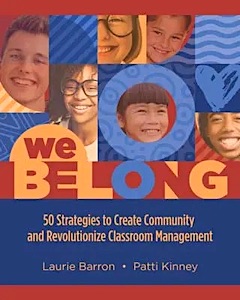
We Belong: 50 Strategies to Create Community and Revolutionize Classroom Management
By Dr. Laurie Barron and Patti Kinney
(ASCD, 2021 – Learn more)
Reviewed by Cathy Gassenheimer
 If you were asked to define classroom management – what would you say?
When I first pulled the book We Belong: 50 Strategies to Create Community and Revolutionize Classroom Management from its ASCD envelope, I put it aside, thinking it was simply a listing of classroom strategies.
I totally missed the key words “We Belong” – key in the sense that these words signaled the WHY of this book, meant to suggest it would be something more than another how-to collection of tips for new teachers.
I also realized that the insights and advice shared by authors Laurie Barron and Patti Kinney came from educators with extensive experience not only teaching in middle grades classrooms but managing schools and districts.
Kinney, a former principal, AMLE president, and leader of middle level programs for NASSP – and Barron, an award winning middle school principal, district superintendent and NBCT – bring a rich systemic perspective to this ambitious enterprise. I was also excited to see that the book’s Foreword was written by Cossondra George, an exceptional Michigan middle school educator I’ve corresponded with for many years.
What does it mean to “manage a classroom”?
So back to the classroom management definition. I imagined it would have something to do with preparation, organization and making connections with students. I was only partially right. The authors define it this way:
“Classroom management can be defined as the strategies and attitudes through which a teacher organizes and operates the classroom environment in order to provide the best possible setting for academic and social-emotional learning (SEL).” (p. 5)
A paragraph later, they note: “Classroom management and belonging are a dynamic duo.” Intrigued – particularly since we have all now experienced education in the context of a traumatic and isolating pandemic – I read on.
I also wondered whether the “belonging” related only to students or to both students and adults in the building. I soon discovered that while most of the 50 strategies described in the book relate to student belonging, there is a strong undercurrent suggesting that successful schools are intentional about creating a culture that is safe, nurturing, and accepting for everyone in the building.
Combining Classroom Management and Belonging
Barron and Kinney offer six “deliberate” actions necessary to combine belonging and classroom management (pp. 8-9):
- Using classroom management practices that create “a comfortable, inviting, respectful setting where everyone is seen as equal and valued.”
- Integrating SEL into the daily learning to promote belonging.
- Valuing and creating learning involving all students by offering a variety of opportunities in both learning and extra-curricular activities.
- Embracing high standards for both learning and behavior, accompanied by the supports necessary for students to be successful.
- Recognizing and involving parents and guardians as a vital part of the school community.
- Practicing what they value: “modeling beliefs, attitudes, and behaviors that promote belonging, equity, and competence for all students.”
Tools You Can Use
Throughout the book, there are downloadable tools that teachers and administrators can use. As an example, a School Safety Checkup tool can be utilized to help make sure school and classroom environments are safe and welcoming. The checkup tool also addresses SEL and psychological safety by helping assess “comfortable” and appropriate relationships with trusted adults. (Everyone can download a complete set of tools from the book, courtesy of ASCD.)
Consistency: Necessary for Learning and Belonging
Ready for a sample? Chapter Four is titled “Belonging Thrives on Consistency.” Some of the strategies addressed include:
Strategy 23: Treat Consistency as a Right. “Consistency is about honoring an obligation…Don’t establish a rule, procedure, or protocol that you do not believe yourself capable of consistently reinforcing, following through on, or holding students accountable for.” (p. 73)
Strategy 24: Set the Behavioral Tone Early. This strategy addresses such actions as treating students with equity, respect, and dignity; modeling the behavior expected from students; accentuating the positive; adopting a problem-solving mode; and prioritizing relationship building.
Strategy 27: Post a Daily Agenda. Students thrive on predictability and knowing what’s expected of them. This part of the chapter offers sample daily agendas for elementary, middle, and high school classrooms.
Strategy 29: Design Guidelines for Classroom Conversations. Much like the old “Mad Libs” that many of us enjoyed growing up, the authors offer prompts ranging from the Rotary Four-Way Test (Is it the truth? Is it fair to all concerned? Will it build goodwill and better friendships? Will it be beneficial to all concerned?) to specific wording that can guide and deepen both teacher and student responses.
Engaged Students, Moving Toward Mastery
As we move deeper into the book, the authors remind us of the importance of failure to learning and mastery (Strategy 42). In most “real-world” situations, when we make a mistake, we are expected to learn from it, correct it, and move on. Unfortunately, too often when students make mistakes, we give them a failing grade and move on without the opportunity to view the mistake as an opportunity to learn.
The authors strongly embrace using mistakes as a learning tool and suggest that letting students fail and then “guiding them to learn from their mistakes is essential to building resilience and helping them become confident, successfully functioning adults” (p. 135).
Actions such as showing empathy, sharing stories of failure, embracing the growth mindset and the power of “yet” can help teachers create a classroom environment where everyone thrives. I particularly liked the section titled “Offer Redos and Retakes,” as the authors ask this important question: Why do we feel it’s wrong to let kids have a second chance?
To build on that important question, the authors compare and contrast the real world with the insulated world of the classroom using the following prompts (pp. 137-138):
- How many of you passed your driver’s test the first time?
- Don’t authors write draft after draft prior to publishing a book?
- And I’ll add a question: How many of you pick up the correct remote when using a new television or digital device?
A Valuable Guide to SEL Integration
The past two years have been challenging for all of us, particularly students and teachers. As we seek to return to a safer and more predictable environment, We Belong can be a valuable easy-to-use resource guide for teachers wanting to connect with their students so that they thrive both academically and emotionally.
Read an article by authors Barron and Kinney:
Kids Need Us to Keep These 25 Promises
Cathy Gassenheimer is Executive Vice President of the Alabama Best Practices Center, a program of the statewide business/community nonprofit A+ Education Partnership in Montgomery. ABPC works directly with educators through three professional learning networks: the Key Leaders Network (school and district leaders), the Powerful Conversations Network (school teams), and the Instructional Partners Network (school-based instructional coaches).
Cathy is currently leading a middle grades leadership project. Her frequent blog posts and reviews appear at The ABPC Blog. Connect with her on Twitter (@cathygassenheim)
[ad_2]
Source link


